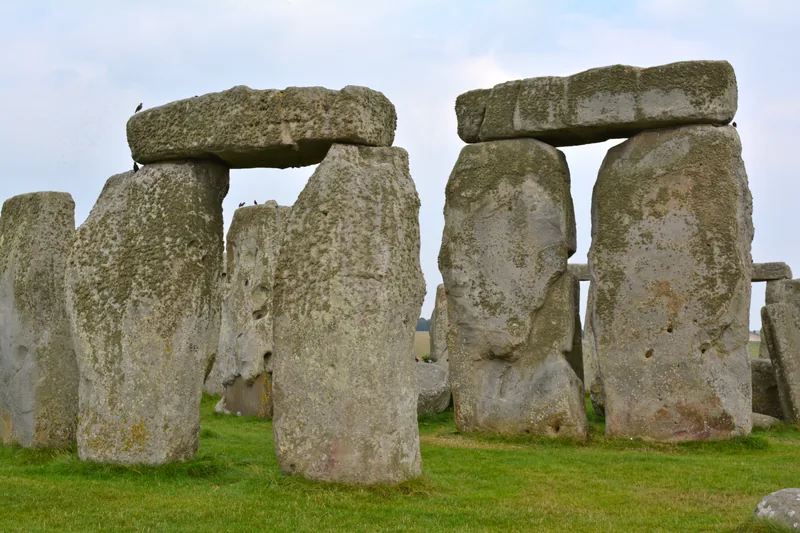
English Heritage calls Stonehenge a masterpiece of engineering, built using only simple tools and technologies, before the arrival of metals and the invention of the wheel.1
To erect a stone, people dug a large hole with a sloping side. The stone was then moved into position and hauled upright using plant fibre ropes and probably a wooden A-frame.1
To erect a stone, English Heritage describes a large hole with a sloping side, plant-fibre ropes, and probably a wooden A-frame.Drawing: our own, simplified and not to scale
To fit the upright stones with the horizontal lintels, mortice holes and protruding tenons were created. The lintels were slotted together using tongue and groove joints. These types of joint are usually found only in woodworking.1
Two sarsen trilithons standing side by side at Stonehenge.Photo: TobyEditor · CC BY 4.0 · CommonsA trilithon uses mortice-and-tenon joints, and the lintels use tongue-and-groove — joints English Heritage says are usually found only in woodworking.Drawing: our own, simplified and not to scale
On average the sarsens weigh 25 tons, with the largest stone, the Heel Stone, weighing about 30 tons.1 The bluestones weigh between 2 and 5 tons each.1
Over 80 large sarsen stones are brought from the Marlborough Downs, 15 miles (25 km) away, and raised in the centre of the enclosure in two concentric arrangements.2 Recent research has not only confirmed that the Marlborough Downs were indeed the source, but has pinpointed the specific area that the sarsens most likely came from: West Woods, south-west of Marlborough.1 Bluestone is the term used for the smaller stones at Stonehenge. These are of varied geology but all came from the Preseli Hills in south-west Wales, in English Heritage wording on that page.1
How the Altar Stone travelled is part of the same 2024 debate: see the stones page.