An open question
Why it was built
English Heritage says Neolithic and Bronze Age people put an enormous effort into building this extraordinary structure, despite the fact that it serves no known practical function.1 Though there is no definite evidence as to the intended purpose of Stonehenge, Britannica says, it was presumably a religious site and an expression of the power and wealth of the chieftains, aristocrats, and priests who had it built.2
On the same page, English Heritage says the interpretation which is most generally accepted is that of a prehistoric temple aligned with the movements of the sun.3
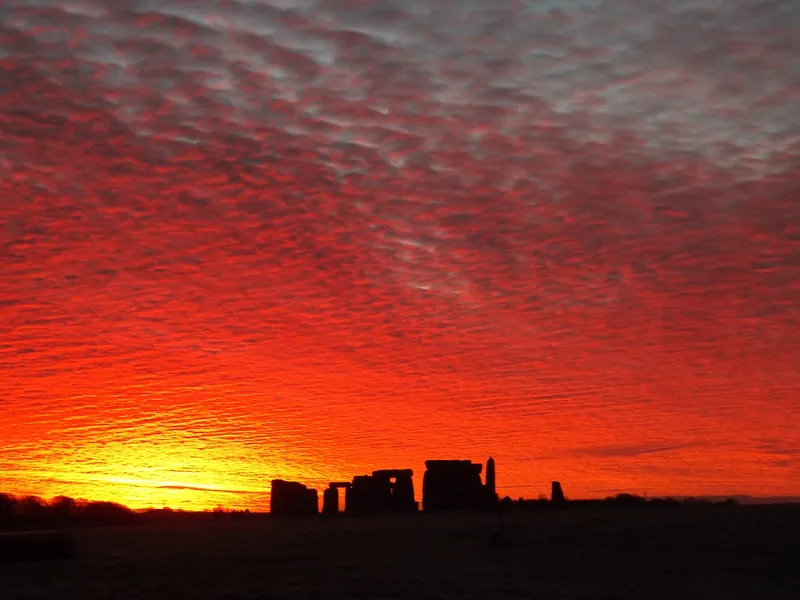
The whole layout of Stonehenge is therefore designed in relation to the solstices, which are the extreme limits of the sun's movement.1 If you were to stand in the middle of the stone circle on Midsummer's Day, you would see the sun rise just to the left of the Heel Stone.1 English Heritage says Stonehenge is likely to have been much more than a calendar.1
Excavations show that the area within the stone circle seems to have been kept clean of everyday debris.1
About 64 cremations have been found at Stonehenge.4 Perhaps as many as 150 individuals were originally buried at Stonehenge, making it the largest late Neolithic cemetery in the British Isles.4
What was Stonehenge for?
English Heritage's "Understanding Stonehenge" page says the structure serves no known practical function, that its layout is designed in relation to the solstices, and that it is likely to have been much more than a calendar. The "Significance" page on the same site says the interpretation which is most generally accepted is that of a prehistoric temple aligned with the movements of the sun. Britannica says there is no definite evidence as to the intended purpose, then sets out several ideas (a religious site, a place to observe the Sun and Moon, a monument to the ancestors, a healing centre) and notes that the Druid-temple idea, and most "computer" claims after Gerald Hawkins in 1963, have been rejected by more recent scholars. A 2008 healing suggestion is followed, in the same Britannica article, by an analysis of human remains that shows no difference in the population's health from other parts of Britain. This site does not crown a single purpose.
Ideas that have not held
In 1963 American astronomer Gerald Hawkins proposed that Stonehenge had been constructed as a "computer" to predict lunar and solar eclipses. Most of these speculations, too, have been rejected by experts.2
In 2008 Tim Darvill and Geoffrey Wainwright suggested that Stonehenge was used in prehistory as a place of healing. However, analysis of human remains from around and within the monument shows no difference from other parts of Britain in terms of the population's health.2
John Aubrey in the 17th century and William Stukeley in the 18th century both believed the structure to be a Druid temple. This idea has been rejected by more-recent scholars, as Stonehenge is now understood to have predated by some 2,000 years the Druids recorded by Julius Caesar.2
Myths that go further still — Merlin, aliens, a slaughter stone used for sacrifice — are on the myths page.