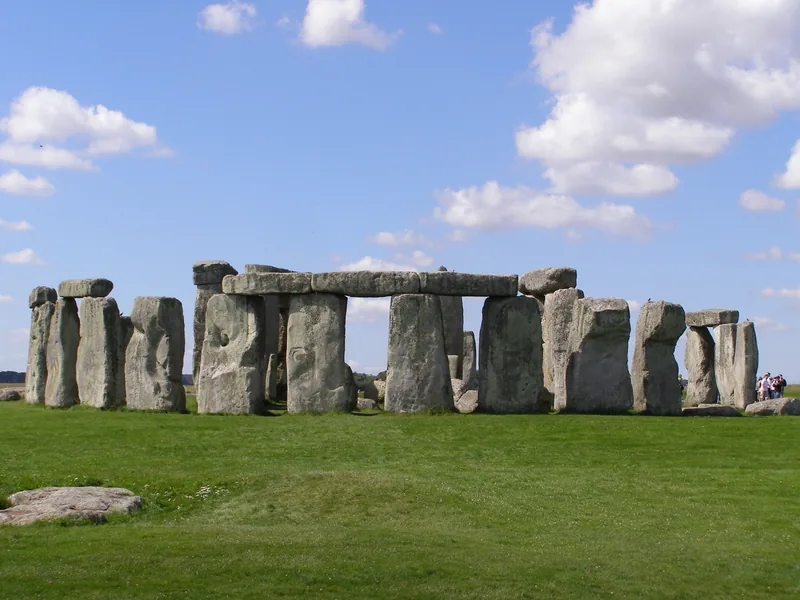
The monument
What is Stonehenge?
English Heritage calls Stonehenge perhaps the world's most famous prehistoric monument.1 Britannica locates Stonehenge on Salisbury Plain, about 8 miles (13 km) north of Salisbury, Wiltshire, England.2
The name of the monument probably derives from the Saxon stan-hengen, meaning "stone hanging" or "gallows."2
Today, together with Avebury, Stonehenge forms the heart of a World Heritage Site, with a unique concentration of prehistoric monuments.1 UNESCO lists Stonehenge, Avebury and Associated Sites as a World Heritage Site, with the date of inscription 1986.3 UNESCO calls Stonehenge and Avebury, in Wiltshire, among the most famous groups of megaliths in the world.3 UNESCO says the two sanctuaries consist of circles of menhirs arranged in a pattern whose astronomical significance is still being explored.3 The property area given on the UNESCO page is 5,152.39 ha.3
Britannica says the monument called Stonehenge was built in six stages between 3000 and 1520 BCE.2 By about 2500 BC, more and much larger stones had been brought there, marking the start of over 800 years of building and alteration stretching into the Bronze Age.4
As a prehistoric stone circle, Britannica says, it is unique because of its artificially shaped sarsen stones, arranged in post-and-lintel formation, and because of the remote origin of its smaller bluestones from 100-150 miles (160-240 km) away, in South Wales.2
English Heritage also calls Stonehenge the world's best-known ancient stone circle.5 The Stonehenge, Avebury and Associated Sites World Heritage statement on that page says Stonehenge is the most architecturally sophisticated prehistoric stone circle in the world, while Avebury is the largest in the world.5
What it was for is a longer question, and not a settled one. The why it was built page keeps the main interpretations in view, including where English Heritage's own pages differ in tone.