Two types, and a third debate
The stones
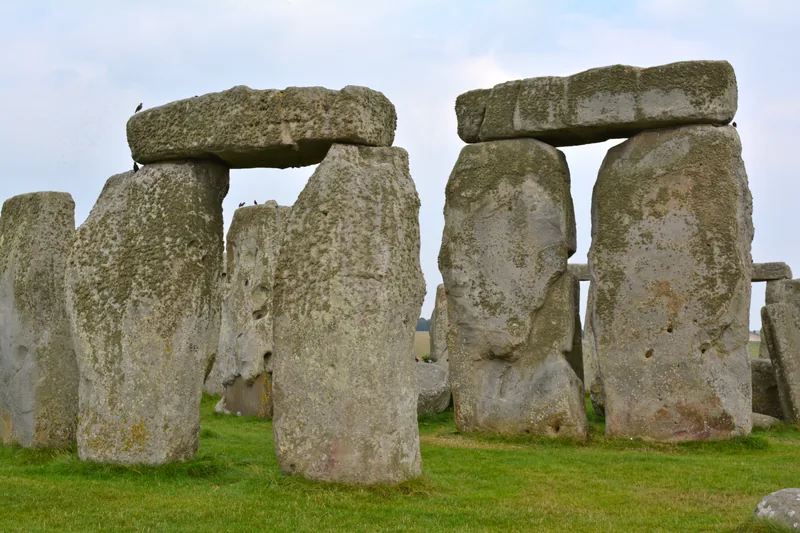
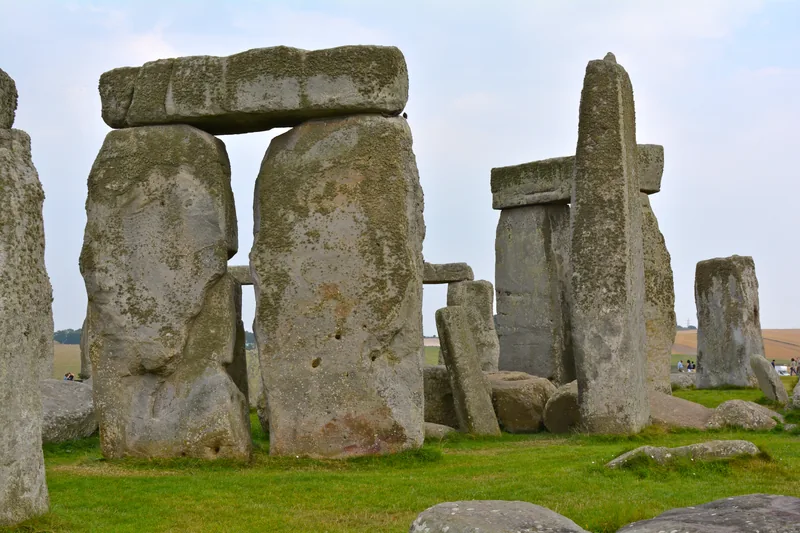
Two types of stone are used at Stonehenge: the larger sarsens and the smaller bluestones.1
Sarsens
The sarsen stones are a type of silcrete rock, which is found scattered naturally across southern England.2 On average the sarsens weigh 25 tons, with the largest stone, the Heel Stone, weighing about 30 tons.2
For many years most archaeologists believed that these stones were brought from the Marlborough Downs, 20 miles (32 km) away, but their exact origin remained a mystery.2 Recent research has not only confirmed that the Marlborough Downs were indeed the source, but has pinpointed the specific area that the sarsens most likely came from: West Woods, south-west of Marlborough.2
Over 80 large sarsen stones are brought from the Marlborough Downs, 15 miles (25 km) away, and raised in the centre of the enclosure in two concentric arrangements.3 On the significance page, the bluestones are said to have been brought from the Preseli Hills, over 150 miles (250 km) away, and the sarsens from West Woods, 15 miles (25 km) north of Stonehenge on the edge of the Marlborough Downs.4
How far did the sarsens travel?
English Heritage's building page says that for many years most archaeologists believed the sarsens came from the Marlborough Downs, 20 miles (32 km) away, and that recent work has pinpointed West Woods, south-west of Marlborough. The timeline page, and the significance page, give 15 miles (25 km) from the Marlborough Downs, and the significance page specifies West Woods, 15 miles (25 km) north of Stonehenge. The source area is the same. The mile figures differ, so this site keeps both and does not pick one distance as the official figure.
Bluestones
Bluestone is the term used for the smaller stones at Stonehenge. These are of varied geology but all came from the Preseli Hills in south-west Wales, in English Heritage wording on that page.2 The bluestones weigh between 2 and 5 tons each.2 Although they may not appear blue, they do have a bluish tinge when freshly broken or when wet.2
Some of the bluestones are likely to have previously stood in a stone circle on the bank of the river Avon at West Amesbury henge, 1 mile (1.7 km) to the south-east.2 Some unspotted dolerite bluestones may originally have been part of a stone circle at Waun Mawn, in the Preseli Hills. Recent excavations there have uncovered empty stoneholes, showing that at least six bluestone pillars were removed from this site in prehistory.2
As a prehistoric stone circle, Britannica says, it is unique because of its artificially shaped sarsen stones, arranged in post-and-lintel formation, and because of the remote origin of its smaller bluestones from 100-150 miles (160-240 km) away, in South Wales.5
The Altar Stone
Near the centre is the Altar Stone, which is mostly buried beneath the fallen stone of the tallest trilithon.6
English Heritage's building page still describes the Altar Stone as made of a type of sandstone found in south-east Wales, in the area of the Brecon Beacons or Black Mountains.2
A 2024 study, published in the journal Nature and summarised by UCL, found that the Altar Stone came from northern Scotland, not Wales.7 The findings show a remarkable similarity between the Old Red Sandstone of the Orcadian Basin in northeast Scotland and the Stonehenge Altar Stone.7 The new discovery implies that the stone was moved much further than had been believed: at least 700 km (435 miles), in UCL's wording.7 UCL quotes the co-author Richard Bevins: the hunt will still very much be on to pin down where exactly in the north-east of Scotland the Altar Stone came from.7
Curtin University, which led the research, describes the Altar Stone as a six-tonne sandstone block.8 Curtin's media release says the chemical fingerprint suggests the stone came from rocks in the Orcadian Basin, Scotland, at least 750 kilometres away from Stonehenge.8 Curtin says transporting such massive cargo overland from Scotland to southern England would have been extremely challenging, indicating a likely marine shipping route along the coast of Britain.8
Where did the Altar Stone come from?
English Heritage's building page still describes the Altar Stone as a sandstone from south-east Wales, in the area of the Brecon Beacons or Black Mountains. A 2024 study published in Nature, summarised by UCL, matches the stone to the Old Red Sandstone of the Orcadian Basin in north-east Scotland, and says it came from northern Scotland, not Wales. UCL quotes a distance of at least 700 km (435 miles); Curtin University, which led the research, says at least 750 kilometres. The exact source within that basin is not yet pinned down, and the route is not settled: Curtin calls a marine shipping route along the coast of Britain "likely," because an overland journey would have been extremely challenging. This site reports both the older English Heritage wording and the 2024 study, and does not treat the Welsh attribution as settled.
How they stand
The inner sarsen arrangement is a horseshoe of five trilithons: two vertical stones capped by a horizontal lintel.6 Of these, three complete trilithons still stand (one fell in 1797 and was re-erected in 1958), and two are partly fallen.6 Around the horseshoe are the remains of the outer sarsen circle, capped with lintels. There were probably once 30 stones in this circle, but many have fallen and most of the lintels and a few uprights are missing from the site.6
Immediately outside the north-east entrance is the Heel Stone, a huge unshaped sarsen boulder.6 The Slaughter Stone sometimes has a reddish colour because rainwater reacts with the iron it contains. English Heritage says this may explain its name, given by Victorian visitors who imagined that Druids had practiced sacrifices here.6